
Why Midwives Tell Mothers Not to Track — And When a Quiet Exception Makes Sense
8 min read1,734 words
Why Midwives Often Tell Mothers Not to Track Everything
One reason some midwives tell mothers not to track every detail is that feeding can very quickly start to feel like a measurement exercise instead of a responsive relationship. Mothers are already carrying enough. They are learning their baby, recovering physically, coping with tiredness, and trying to build confidence at the same time. In that setting, too much tracking can become one more burden rather than one more form of support.
That caution does not usually come from the idea that records are always bad. It comes from the fact that many mothers do not need another reason to look away from the baby and back toward a screen. They do not need one more system telling them to doubt what they are seeing and feeling in the moment.
In practice, the problem is rarely the existence of information itself. The problem is the weight the information starts to carry. What began as a simple note can become a source of pressure, comparison, guilt, or second-guessing. That shift happens quietly, and once it happens, the app is no longer serving the mother well.
Why Feed Tracking Can Become Unhelpful
Many mothers start out wanting a calm record and end up feeling ruled by timestamps. They begin by hoping to remember which side they used last or how long it has been since the previous feed. Very quickly, though, the record can start acting like a standard the day is supposed to match. If the baby wants to feed “too soon,” the mother worries. If the spacing looks irregular, the mother worries. If the app history looks messy, the mother worries.
That is one reason many midwives and breastfeeding advisors are cautious. Babies are not little machines producing neat outputs on a schedule. Some days are clustered, some are stretched, some are unsettled, and some are simply hard to interpret in real time. A tracking system that overemphasises order can make ordinary variation feel like failure.
This is also why cue-reading matters so much. A mother looking at her baby’s body language, restlessness, rooting, and overall rhythm is often getting information that no timer alone can provide. If the log becomes more important than the baby’s cues, the mother is no longer being helped by the tool. She is being pulled away from what matters most.
Why the Phone Can Matter More Than the Numbers
A major part of the concern is often less about the numbers themselves and more about what the phone does to the feeding moment. When a mother has to keep unlocking the phone, opening an app, starting a timer, editing entries, and checking what happened last time, the device begins to sit in the middle of the relationship between mother and baby.
That matters because feeding is already an occupied moment. A mother may be adjusting position, supporting the baby’s head, managing discomfort, reaching for water, or trying to stay calm when the day has already been long. In that moment, asking her to operate a phone well is often asking too much. It is one reason the ideas in Why Some Midwives Are Cautious About Tracking Feeds ring true across so many real conversations.
If the technology makes a mother feel more distracted, more self-conscious, or more like she is “performing feeding well,” many professionals will suggest stepping back from the tracking. Her attention is worth protecting.
So When Does a Quiet Exception Make Sense?
A quiet exception starts to make sense when the tool is light enough that it does not compete with the feed. It makes sense when the record helps a tired mother remember what happened without demanding constant analysis. And it makes sense when the tool makes it easier to stay present rather than harder.
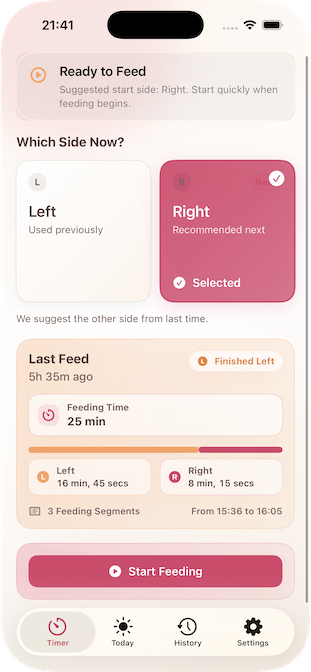
That is where Feeding Timer Lite can be different. The exception is not because mothers suddenly need more data. The exception is because a very light, practical, and hands-free approach can reduce burden instead of increasing it.
In other words, the exception is not “tracking is good now.” The exception is “this version of tracking does not behave like the kind many midwives worry about.” That distinction is important. It keeps the focus where it belongs: on whether the tool genuinely supports the mother using it.
Why Hands-Free Makes a Real Difference
The biggest reason Feeding Timer Lite can be the exception is simple: Siri can handle part of the job. That matters more than it might sound. If a mother does not have to keep using her hands to manage the record, the app becomes much less intrusive. It stops acting like a taskmaster and starts behaving more like a quiet helper.
That is why the hands-free model described in Why Feeding Timer Lite Works Hands-Free With Siri is so relevant from a professional point of view. It directly addresses one of the strongest objections many professionals have: that tracking can demand too much attention in the middle of a feed.
When Siri carries the practical action, the mother can stay with the baby. She can notice comfort, rhythm, and cues while the record quietly gets made in the background. That is a very different experience from stopping to manually manage an app every time.
If a mother wants that lighter approach, there is a direct route to Feeding Timer Lite on the App Store without having to search for it later.
Why It Matters That the Pattern Can Be Reviewed Later
Another reason a quiet exception can make sense is that a good record does not have to be interpreted in the middle of the feed. That is a crucial point. During the feed, the mother’s job is to feed, respond, adjust, and stay as calm as she can. Later, once the baby is settled or asleep, she may have the headspace to look at the broader pattern and ask whether the day is following a rhythm or whether something has shifted.
A tool like Feeding Timer Lite can support that separation. It lets the feed stay present-tense while still preserving enough information for later reflection. That makes it much less likely to interfere with responsive care. It also means the mother does not have to trust exhausted memory alone when she finally has time to think.
The emotional value of that kind of later clarity comes through in How Logging Feeds Gave Me Peace of Mind. A log is most useful when it quiets the mind later, not when it crowds the feed now.
Why Some Midwives Can Support It in Specific Cases
There are times when a simple record genuinely helps a professional conversation. A mother may say the evenings have become much more intense, that the feeds feel closer together, or that she cannot tell whether yesterday was unusual or whether a pattern has been building for days. In those conversations, a light record can be useful. Not as the final word, but as a clearer starting point.
That is another reason the exception exists. When the app is not driving anxiety, and when it is not replacing cue-reading, it can help mothers describe what they have been seeing more clearly. It can reduce the blur of tired memory and help shape a calmer, more grounded discussion with a midwife or breastfeeding advisor.
The important point is that the tool should support judgment, not override it. Feeding Timer Lite works as an exception because it can sit in that supporting role. It helps the mother bring something concrete into the conversation, while still leaving room for professional interpretation and real-world context.
What Makes This Exception Objective Rather Than Emotional
If the exception is explained objectively, it comes down to a few practical conditions. The tool should reduce friction, it should not demand frequent manual interaction, it should preserve the difference between recording and interpreting, and it should encourage mothers to use the information as support rather than as law.
Feeding Timer Lite meets those conditions more easily than many tracking tools because it is simple, because Siri can help with the practical side, and because its best use is as a background memory aid. Those are not sentimental reasons. They are practical ones. They are the exact reasons a cautious professional may find this tool more acceptable than heavier, more demanding tracking systems.
That does not mean every mother should track. It means the usual objections become weaker when the app asks very little from her in the moment. And that is precisely what makes the exception reasonable.
Why the Exception Still Has Limits
Even with a lighter tool, the order of importance still matters. The baby comes first. The cues come first. The relationship comes first. The app is there to serve those things, not to replace them. If the record starts increasing anxiety, creating obsession, or making a mother feel trapped by what the timer says, then it is time to step back again.
That limit matters because it keeps the exception healthy. It stops the tool from drifting into the same problems that make many professionals cautious in the first place. The reason to allow the exception is not that technology has suddenly become more trustworthy than the lived feeding relationship. It is that this particular tool can stay modest enough to be helpful.
And when a mother decides that this low-pressure, hands-free kind of record would help her more than it would burden her, she can go straight to the Feeding Timer Lite App Store page at that point.
Closing Thought
When midwives tell mothers not to track, it is usually because they want to protect confidence, attention, and the relationship with the baby. They want feeding to stay responsive, not over-managed. They want the mother to feel supported, not scored.
The quiet exception exists when the tool is humble enough to stay in the background. Feeding Timer Lite can be that exception because it is simple, because Siri reduces the handling burden, and because it helps mothers remember without demanding constant interpretation. That is why, from a cautious professional perspective, it can make sense where many heavier tracking tools do not.
That is the rule and the exception in the clearest possible terms: do not track if tracking is pulling you away from the baby, but do consider a lighter, hands-free memory aid when it genuinely makes care calmer and clearer.

Feeding Timer Lite - Available Now
The live App Store version for mothers and caregivers who want quick feed timing, side memory, and a calmer overview of the day without clutter.

Breast Feeding Timer – Coming Soon
One-tap start and stop for left and right feeds, clear timers, and daily stats — designed for those quiet hours when every second counts.
Download Breast Feeding Timer App NowLast updated: 7 April 2026 at 22:47
Continue reading

7 Apr 2026
Why Some Midwives Are Cautious About Tracking Feeds
Some midwives and breastfeeding advisors worry that feed tracking can create stress, rigidity, and too much focus on the phone. Feeding Timer Lite is different when it is used as a calm, hands-free memory aid rather than a rulebook.

7 Apr 2026
Why Feeding Timer Lite Works Hands-Free With Siri
Feeding Timer Lite is designed so mothers do not have to manage a phone in the middle of a feed. Siri can capture the moment hands-free, while the pattern stays ready to review later when there is real space to think.

5 Apr 2026
How Siri Helps Me Track Breastfeeding With Feeding Timer Lite
When one hand is holding the baby and the other is reaching for water, Siri can be the easiest way to start or stop a feed without breaking the moment.
Explore Expert Videos
Prefer watching? Browse our curated, doctor-led videos on key topics like breastfeeding, hunger cues, and routines.
Browse Videos